NLP Coaching in Central London and Reading
Modern, practical NLP coaching for clearer thinking, greater confidence and meaningful change – available in Central London, Reading and online.
People often look for NLP coaching because they feel stuck in a repeating pattern. You may be overthinking, hesitating, losing confidence under pressure, struggling with an old habit or finding that the same emotional reactions keep getting in your way.
NLP – Neuro-Linguistic Programming – offers practical ways to understand how your thoughts, language, emotions and behaviour interact. By becoming more aware of those patterns, you can begin to respond differently and create more choice in the situations that matter.
I’m Matthew Exell, a qualified and insured NLP coach and Master NLP Practitioner. With over 18 years of professional experience, I combine NLP with life coaching, positive psychology, EFT and cognitive hypnotherapy to create an approach tailored to you.
I offer NLP coaching in Central London, Reading and online throughout the UK and internationally.
Call 07807 540142 or email me to ask a question or arrange a session.
What NLP Coaching Can Help You Change
You can know logically what you want to do and still find yourself reacting in the old way. That does not mean you are weak or incapable. Many responses become familiar and automatic through experience, repetition and the meanings we have learned to attach to events.
NLP coaching helps us slow those patterns down, understand how they work and explore more useful alternatives. The aim is not to tell you what to think. It is to help you develop greater awareness, flexibility and control over how you respond.
- Overthinking, racing thoughts and mental noise
- Stress, worry and emotional overload
- Confidence, self-belief and imposter syndrome
- Procrastination, avoidance and difficulty taking action
- Habits and behaviours that feel automatic
- Fear of judgement, criticism, failure or success
- Communication, relationships and healthy boundaries
- Career decisions, leadership and workplace performance
- Sport, creativity, focus and performance under pressure
- Feeling stuck despite knowing what you “should” do
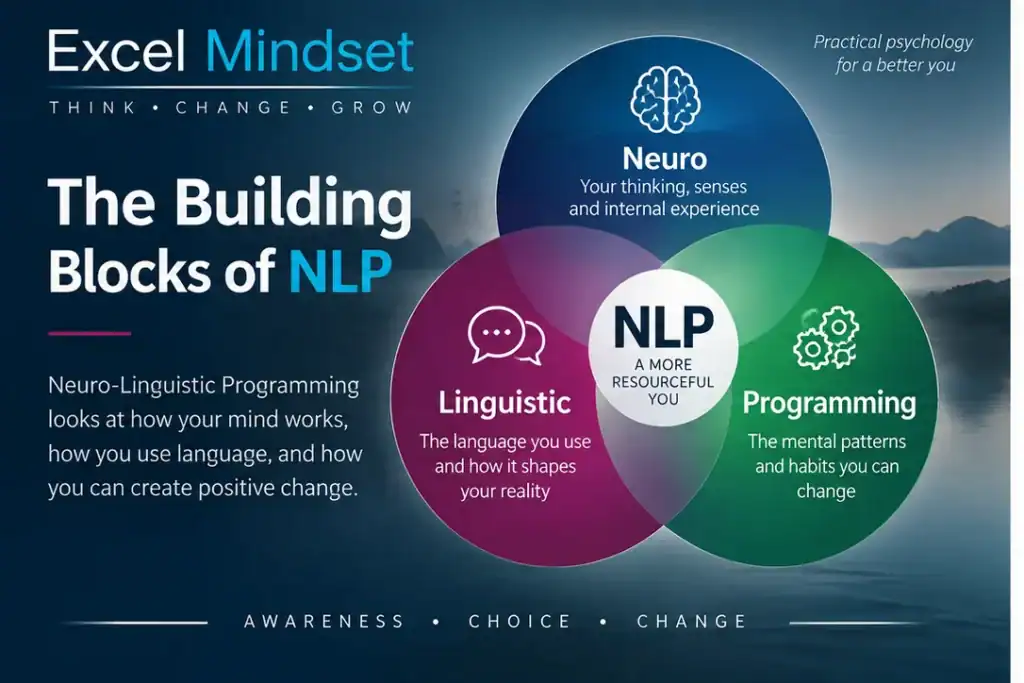
What Does NLP Mean?
Neuro
This refers to how we receive and process experience through the nervous system and our senses. We notice some information, filter other information and create an internal response shaped by memory, attention and emotion.
Linguistic
This refers to language – both the words we use with other people and the internal language we use with ourselves. Language can shape attention, interpretation, expectations and the meaning we give to an experience.
Programming
This refers to the learned patterns and habits that influence our choices and behaviour. “Programming” does not mean that people are machines. It is a useful way of describing responses that have become familiar through repetition and can therefore be reviewed, adapted and practised differently.
In simple terms, NLP explores how you organise your experience and how changing part of that organisation may create a different response.
A Modern, Mind-Body Approach to NLP
My approach is conversational, grounded and adapted to the individual. It is not based on forcing positive thoughts or following a rigid script. We pay attention to how your mind and body respond in real situations, particularly when you feel uncertain, challenged or under pressure.
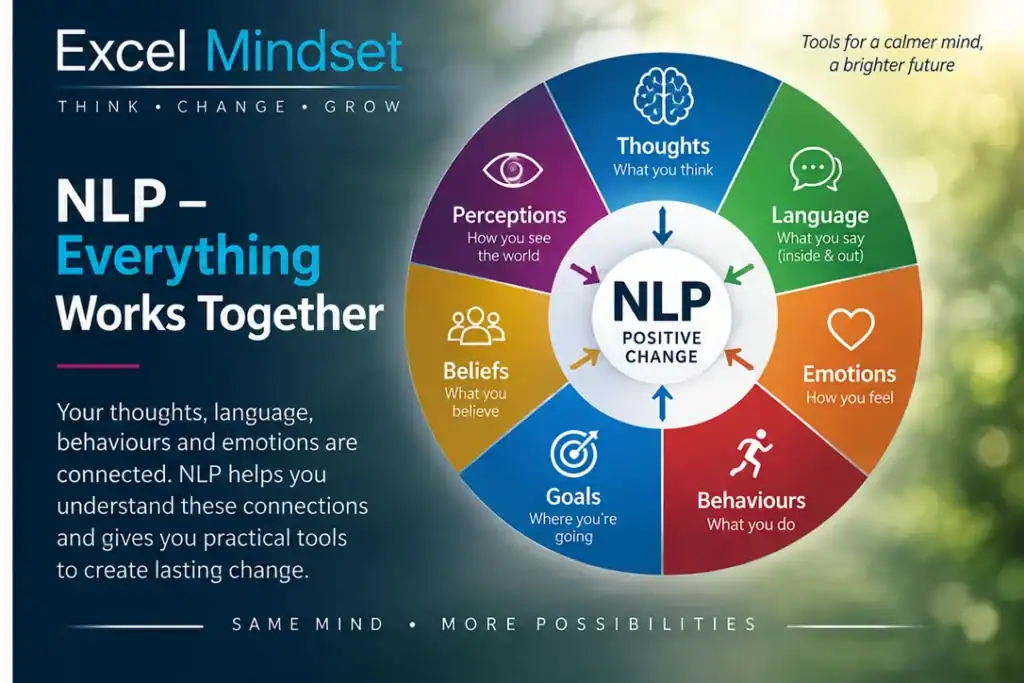
We may explore your internal dialogue, emotional state, beliefs, attention, physical sensations, language and behaviour. By understanding how these elements connect, we can identify where a small change may interrupt an old pattern and make a more helpful response possible.
You do not need to be naturally visual or good at imagining pictures. NLP can be adapted to work through words, sensations, emotion, movement, sound, understanding and felt experience. This includes people with aphantasia or other non-visual thinking styles.
Past, Present and Future
I often combine NLP with coaching and hypnotherapy because change can involve the past, present and future. We may need to think differently about something that has happened, develop a better response to what is happening now and create a clearer sense of where you want to go next.
- The past: understanding learned meanings, emotional associations and patterns without becoming trapped in them.
- The present: developing practical ways to regulate your state, communicate clearly and make different choices.
- The future: clarifying goals, rehearsing useful responses and turning intention into action.
The balance will differ from person to person. Some clients want to understand an old pattern, while others mainly want practical support with a current decision or future goal.
Key Areas NLP Coaching Often Supports
Overthinking and Anxiety
Overthinking often tries to create certainty, but can instead produce more doubt and mental pressure. NLP coaching can help you notice the sequence that turns a thought into a loop, then practise ways to interrupt it, widen your attention and respond more calmly.
Confidence and Imposter Syndrome
Confidence is not simply positive thinking. It is influenced by your internal language, emotional state, expectations and previous experiences. We can explore what changes when confidence disappears and develop a more stable way of approaching challenging situations.
Business, Careers and Communication
NLP can be useful for communication, leadership, negotiation, presentations and difficult conversations. Understanding that other people may organise experience differently can improve empathy and help you communicate with greater precision and flexibility.
Habits and Behavioural Change
A habit is often connected to a particular trigger, state or expectation. Rather than treating the behaviour as an isolated problem, we look at what happens before it, what it provides in the moment and what alternative response could meet the same need more constructively.
Performance, Sport and Creativity
Pressure can narrow attention and increase internal noise. NLP coaching can support focus, motivation, emotional regulation and the ability to recover after setbacks. This may be useful for athletes, performers, professionals and creative people who want to access their skills more consistently.
Relationships and Boundaries
Relationships are shaped by communication, interpretation and repeated emotional responses. NLP can help you become more aware of how you communicate, recognise different perspectives and express your needs with clearer, healthier boundaries.
Maps, Meaning and Limiting Beliefs
A central NLP idea is that “the map is not the territory”. We do not respond to every detail of reality; we respond to our own internal map of it. Two people can experience the same event and give it very different meanings.
Our maps are shaped by experience, culture, language, expectations and habit. They are useful, but they can also become restrictive. A belief such as “I’m not good enough”, “nothing will change” or “I can’t cope” may feel like a fact even when it is only one interpretation.
NLP coaching helps you examine how a belief is maintained, what it causes you to notice or ignore and whether it still serves you. The purpose is not to replace one slogan with another, but to create a broader and more realistic range of possibilities.
What Happens in an NLP Session?
Sessions are relaxed, focused and tailored to the way you think. We begin by clarifying what you want to change and what a useful outcome would look like in everyday life.
- We identify the situation, response or pattern you want to change.
- We map how your thoughts, language, emotions and body respond.
- We explore what keeps the pattern going and where greater choice can be created.
- We use suitable language-based, state-based or behavioural exercises.
- We agree practical ways to apply and reinforce the change between sessions.
- At the next session, we review what has changed and decide what will be most useful next.
Most people notice useful changes within 3–5 sessions, although the number of sessions depends on the person, the goal and the depth of the pattern. Each session lasts approximately one hour.
NLP in Central London, Reading and Online
I work with people from a wide range of personal and professional backgrounds. You can choose the location or format that fits your circumstances:
- Central London: convenient for people who live or work in London.
- Reading: in-person NLP coaching for Reading and the surrounding Berkshire area.
- Online: private sessions by video for clients across the UK and internationally.
Online NLP coaching can be just as focused and personal as meeting in person. You simply need a reliable connection and a quiet place where you can speak freely without being disturbed.
Frequently Asked Questions
Do I need to visualise?
No. My approach can work through language, emotion, sensation, understanding and state, so it can be adapted for people who do not naturally visualise.
Is NLP the same as hypnotherapy?
No. They are different approaches, although they can complement each other. NLP focuses on patterns of language, meaning, state and behaviour. Hypnotherapy uses focused relaxation and attention. I will explain any proposed approach so that you can decide what feels right for you.
How many sessions will I need?
Many clients find that 3–5 sessions provide useful progress. Some people need fewer sessions for a focused goal, while others prefer longer-term support for broader or more established patterns.
Can NLP be used alongside life coaching?
Yes. Life coaching helps clarify goals and practical next steps, while NLP can help address the internal patterns that affect whether those steps feel possible and sustainable.
Begin Creating Real Change
If you are ready to understand an old pattern, think more clearly and feel more able to choose your response, NLP coaching may be a useful next step. We can discuss what you want to change and decide whether sessions in Central London, Reading or online would suit you best.
Call 07807 540142 or email me today.